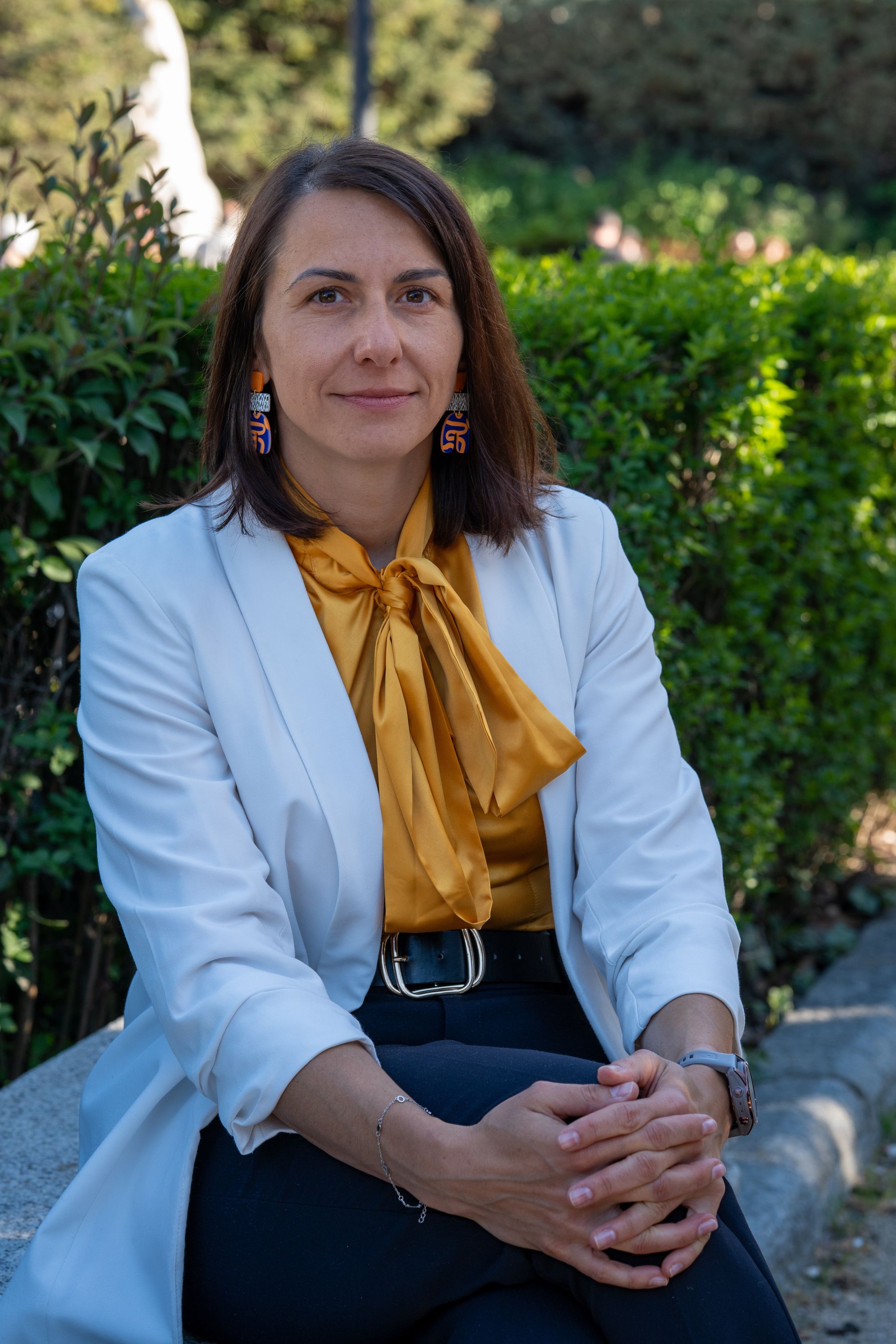
Karolina Broskova

Karolina Broskova · Madrid

I grew up believing that the best moments in life happen around a table — when the food goes cold because the conversation has caught fire.

I am Karolina Broskova — a facilitator, a coach, and an incorrigible believer in the power of human conversation. I was born in the Czech Republic, shaped by Central European intellectual life, and I have spent the last years living in Madrid — a city that, I discovered, has exactly the right temperament for what I wanted to build.

Mindsalon is not a business idea I arrived at. It is something I arrived at through living — through every conversation that left me more alive, and every social gathering that left me lonelier than before I arrived.

This is the story of how I got here.

A childhood shaped by gathered people

Growing up, my home was often full of people. Not parties — gatherings. Adults who came to talk seriously about ideas, about the world, about what mattered. I was young enough to be invisible, old enough to listen. And what I absorbed, sitting quietly in corners, was this: people become more themselves in the right company. Something unlocks. A generosity of spirit appears that ordinary life rarely demands.

I didn't have a name for what I was witnessing. I just knew I wanted to spend my life in rooms like that.

What happens when connection becomes performance?

By the time I was an adult, something had shifted in the social world around me. Gatherings multiplied — but depth didn't. We became extraordinarily connected and, simultaneously, extraordinarily alone. I watched people perform versions of themselves at dinner parties, scroll through their phones at restaurant tables, mistake the volume of their social lives for the richness of them.

I felt this too. I was not immune. I went to many evenings that looked meaningful from the outside and felt hollow from the inside. And I kept asking myself the same question: what would need to be different for real conversation to happen?

That question became a kind of obsession — and eventually, an answer.

"I went to many evenings that looked meaningful from the outside and felt hollow from the inside. I kept asking: what would need to be different?"
— Karolina Broskova

Discovering the salon tradition

I came across the history of the French salons almost by accident — reading about 17th-century Paris, about the women who hosted these gatherings in their homes and created, in the process, some of the most generative intellectual communities in Western history. The philosophes didn't write their ideas in isolation and then share them. They talked them into existence, in salons, over years, in conversation.

I remember reading this and feeling something click. Here was the answer to my question. Not a new social format — an ancient one, elegantly solved. Small groups. Curated guests. A theme that matters. A host who holds the space. The domestic setting as a deliberate choice. No performance required.

All it needed was someone willing to do it again.

A city that knows how to talk

I moved to Madrid not with Mindsalon in mind, but Madrid had its own ideas. It is a city where people still linger at tables. Where conversation is considered a legitimate use of an entire evening. Where the culture of the tertulia — the Spanish tradition of gathering to discuss ideas — runs quietly beneath the surface of everyday life.

And it is a city full of international people who have left one home and are building another — people who carry within them a particular kind of openness, a particular hunger for real connection that comes from having crossed a threshold. These are exactly the people I wanted to gather.

I hosted the first Mindsalon in a small apartment in the centre of the city. Six people. Two hours. A theme I had chosen carefully. And something happened that evening that I hadn't quite dared to expect: strangers became real to each other. Not acquaintances — real. It was the room I had been looking for since childhood.

"Strangers became real to each other. Not acquaintances — real. It was the room I had been looking for since childhood."
— On the first Mindsalon, Madrid 2024

When the salon moved into one-to-one

As the salons grew, something began to happen that I hadn't anticipated. Guests would stay behind after the evening ended — or write to me days later — wanting to continue. Not the group conversation, but a more personal one. One that was about them, specifically. About the question that had surfaced during the evening that they couldn't quite let go of.

Coaching found me through that door. I trained formally because I wanted to be trustworthy in that space — to hold it properly, not just instinctively. But the philosophy is the same as the salon: I believe that people carry their own answers. They often simply need the right conditions — the right questions, the right quality of attention — for those answers to become audible.

My coaching practice is not separate from Mindsalon. It is its quieter, more intimate room.

Intellectual Influences

Thinkers who shaped the work

Mindsalon stands on the shoulders of those who understood, before me, that conversation is not just how we communicate — it is how we think, how we heal, and how we become.

01

Martin Buber

His philosophy of the "I–Thou" relationship — the idea that genuine encounter transforms both parties — is the ethical foundation of everything I do.

02

Hannah Arendt

Her insistence on the public space of appearance — where we become who we are through speech and action with others — gave me a political vocabulary for why salons matter.

03

Esther Perel

Her work on relationship and desire reminded me that the most important human questions are rarely the ones we ask aloud — and that creating space for them is itself a radical act.

04

David Bohm

His concept of dialogue as a collective thinking process — something qualitatively different from debate or discussion — gave me the theoretical backbone for how I facilitate.

05

Sherry Turkle

Her research on how technology reshapes human connection convinced me that what Mindsalon offers is not nostalgic — it is urgent.

06

The Salon Tradition

Marie-Thérèse Rodet Geoffrin, Madame de Staël, Gertrude Stein — the great salon hosts who understood that the right room changes what is thinkable.

What I Believe

The convictions that guide the work

Conversation is not a soft skill

It is the primary technology of human civilisation. Every meaningful thing we have built together — ideas, institutions, relationships — began with someone talking to someone else.

Small is not a compromise

Six people in a room is not a scaled-down version of something larger. It is its own distinct phenomenon — with a depth, an intimacy, and a generative power that no larger gathering can replicate.

The host is not the expert

My role in both the salon and the coaching room is to create the conditions for something to happen — not to determine what that something is. The wisdom is always in the room.

Belonging is not given — it is made

Every Mindsalon gathering is a deliberate act of making belonging possible. It requires intention, craft, and care. It does not happen by accident.

Ready to find your room?

Every gathering begins with a single conversation.

Begin the Conversation Discover the Salon